
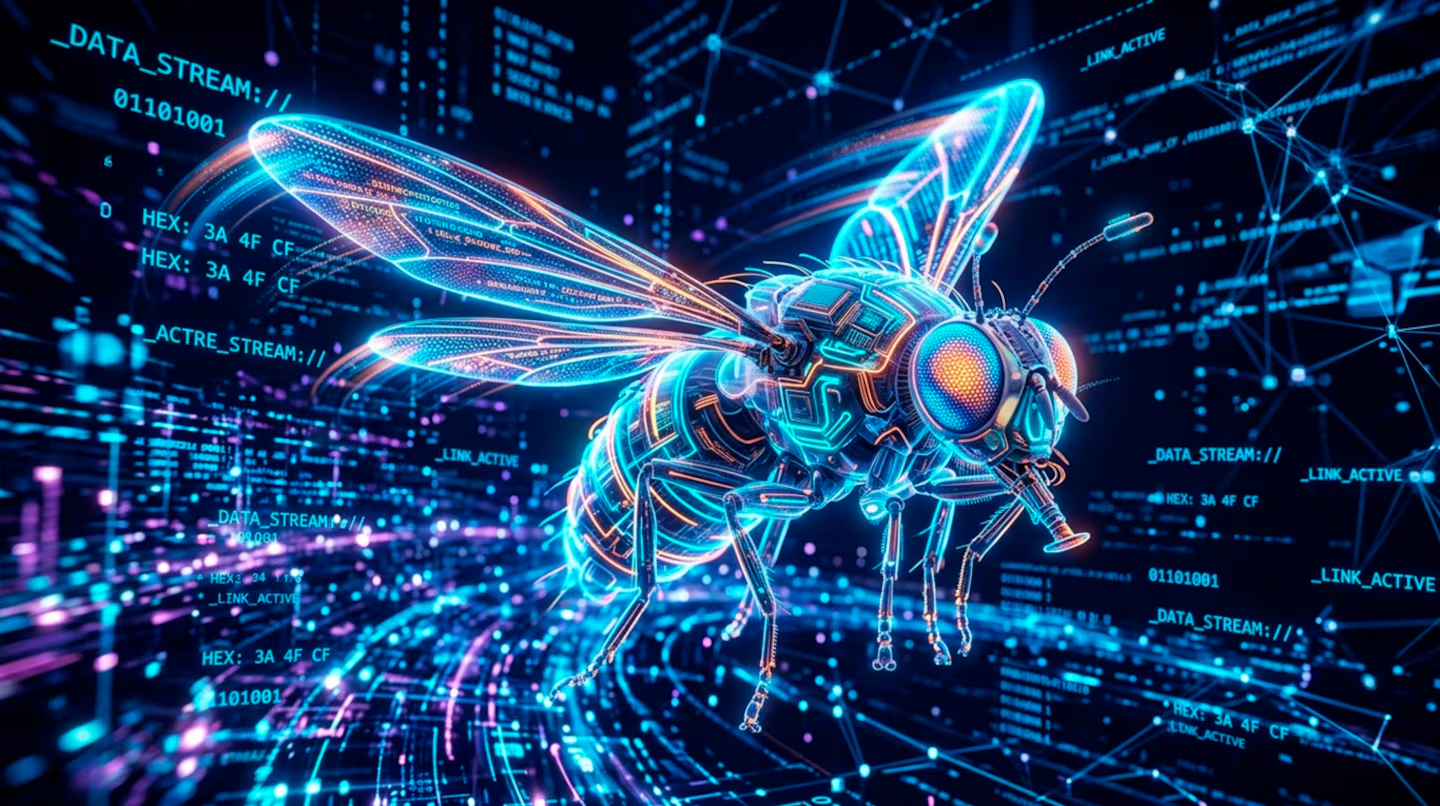
A technological experiment has once again stirred the debate about the future of artificial intelligence. The company Eon Systems claims to have replicated the complete brain of a fruit fly within a computational simulation, creating a digital fly capable of moving and behaving without prior training.
A Digital Fly That Moves Without Having Been Trained

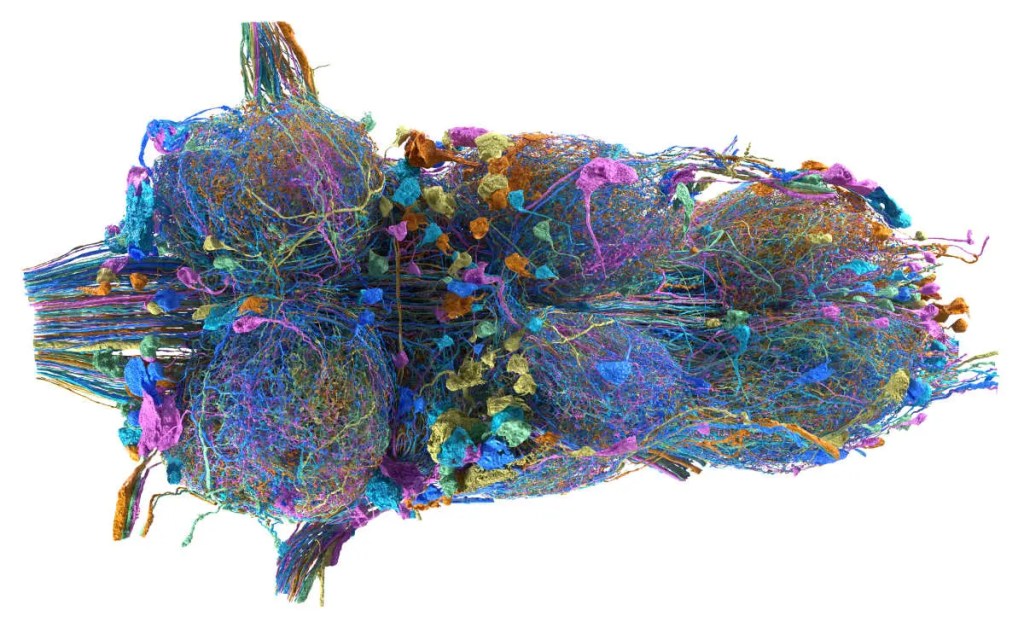
The research presented by Eon Systems proposes a radically different approach from the one currently dominating the development of artificial intelligence. Instead of training systems with huge amounts of data, the experiment attempts to directly copy the structure of a real organism’s brain and run it within a simulation.
To achieve this, the company used the complete connectome of an adult fruit fly, that is, the detailed map of all its neurons and connections. This brain contains approximately 125,000 neurons and nearly 50 million synaptic connections. Although these figures are tiny compared to the human brain, mapping each neuronal link required years of scientific work using electron microscopy and computational reconstruction.
Eon Systems took that biological map and integrated it into a digital simulation connected to a virtual fly body. To make it possible, it used the NeuroMechFly system along with the MuJoCo physics engine, tools also used in advanced robotic simulations.
The result, according to the developers, was surprising. The digital fly began to execute recognizable behaviors such as walking, grooming, and even showing signs associated with egg-laying. Most striking is that these behaviors were not manually programmed nor emerged from reinforcement training. In theory, they emerged from the very neuronal wiring copied from the real brain.
This detail is crucial because it suggests that certain biological behaviors could arise directly from brain architecture, without the need for artificial data-based learning.
An Alternative Approach Toward Artificial General Intelligence

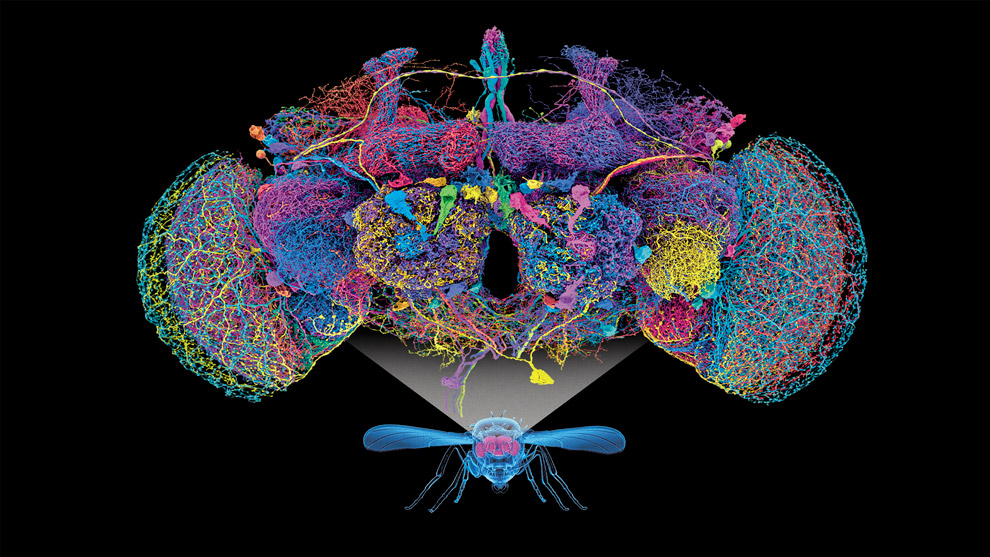
The experiment raises a profound question about the future of artificial intelligence. Currently, the most advanced systems—like large language models—are trained with enormous volumes of information to identify patterns and generate responses. In robotics, reinforcement learning is frequently used, where systems improve through millions of attempts and rewards.
Eon Systems’ approach tries something different. Instead of teaching a machine to behave like an animal, it seeks to reproduce that animal’s brain and allow behavior to emerge naturally within another physical or virtual support.
However, the experiment still presents important limitations. The described simulation does not include neurochemistry, a fundamental element in real brain functioning. Biological systems depend not only on electrical signals between neurons but also on complex chemical interactions that influence emotions, motivation, learning, and memory.
Additionally, the model does not incorporate glial cells, which perform essential support and maintenance functions in biological brains. Nor does it allow continuous learning, since the scanned brain corresponds to a dead fly and represents only a fixed snapshot of its neuronal wiring.
Despite these limitations, the experiment is considered a relevant proof of concept. If copying a brain’s structure can generate recognizable behaviors in a simulation, some researchers believe this strategy could scale toward more complex organisms in the future.
The simulation of a fly’s brain does not immediately bring humanity closer to replicating a human mind, but it does open a new line of research in artificial intelligence. If behavior can emerge from copied neuronal architecture, the path toward more advanced forms of intelligence might not depend solely on data.
Reference
- Nature/Whole-brain annotation and multi-connectome cell typing of Drosophila. Link
COMPARTE ESTE ARTICULO EN TUS REDES FAVORITAS:

Esta entrada también está disponible en:


Discover more from Cerebro Digital
Subscribe to get the latest posts sent to your email.