

Neuroscientists achieved a sci-fi breakthrough: linking three human brains, enabling real-time thought-sharing and task collaboration. Though rudimentary/experimental, this multiperson brain interface marks a milestone potentially revolutionizing human communication.
BrainNet: The “Social Network” of Brains

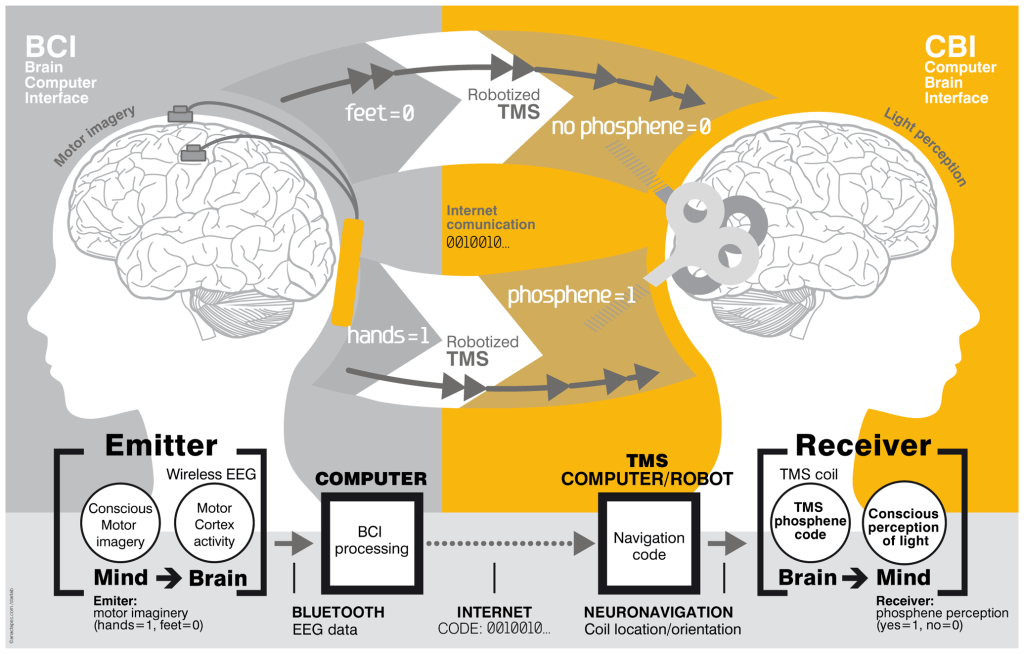
BrainNet—developed by University of Washington/Carnegie Mellon researchers—is the first noninvasive direct brain-to-brain interface for >2 people. Initial goal: mentally collaborate on Tetris-style game.
Combines EEG (records brain electrical activity) + TMS (magnetic fields stimulate brain areas). Enables direct info exchange sans verbal language, screens, keyboards.
Three subjects: two “senders” (EEG electrodes), one “receiver” (TMS device). Senders decided if falling block needed rotation via blinking LEDs (15/17 Hz frequencies creating distinct EEG signals).
Decision transmitted to receiver’s brain via magnetic stimulation, producing phosphenes (illusory light flashes). Phosphene signaled “rotate block.” Purely brain signals—no words.
Five groups achieved 81.25% average accuracy—impressive for 1-bit-at-a-time system.
Future of Human Interaction?

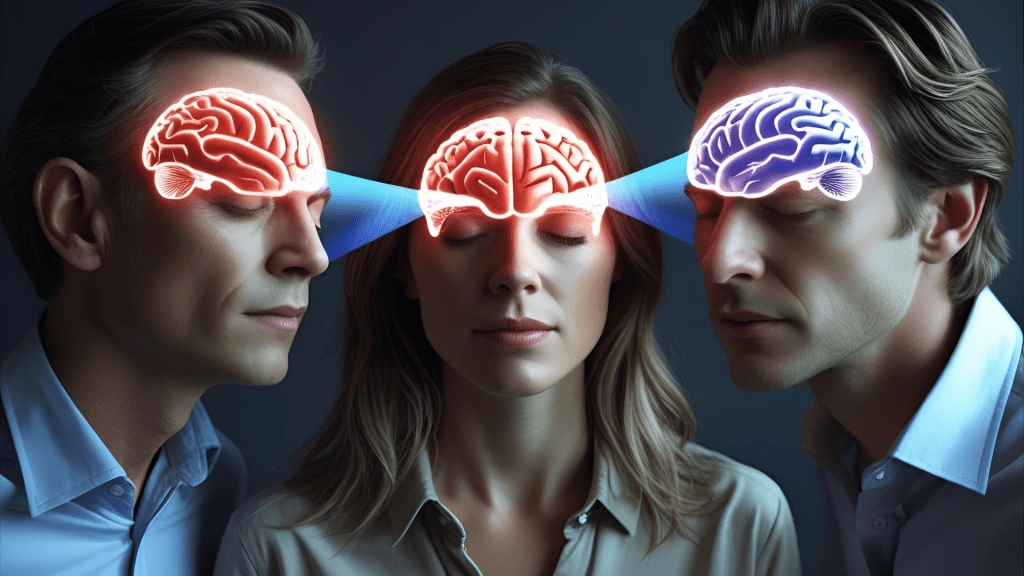
BrainNet slow/controlled, yet researchers see transformative communication potential.
Striking: after rounds, receivers discerned more reliable sender via brain signals alone. Nonverbal reliability assessment opens collaborative systems with joint cerebral—not individual/hierarchical—decisions.
Prior work linked two brains for 20 Questions via binary phosphene “yes/no.” Steady progress toward minds interlinked as neurological “social network” nodes.
Researchers’ arXiv preprint: “Results suggest future brain-to-brain interfaces enabling cooperative human problem-solving via connected brain network.”
Thought-sharing sans speech—long sci-fi trope—now functional, if limited.
Ethical/Scientific Implications
BrainNet raises profound ethics/philosophy: mental privacy with direct thought access? Manipulation/memory implantation? Individual identity fusion in mass connections?
Current system handles simple binaries—not complex “mind reading.” But advancing AI/neuronal interfaces may lift limits.
“Brain summing” promises medicine, education, global problem-solving: fluid mental teams sans misunderstandings, faster collective decisions.
Three-brain BrainNet success pioneers telepathy from fantasy to science—nascent but real. Each transmitted cerebral bit expands communication beyond language, distance, time: thought-based social network emerging.
Reference:
- arXiv/BrainNet: A Multi-Person Brain-to-Brain Interface for Direct Collaboration Between Brains. Link
- Plos One/Conscious Brain-to-Brain Communication in Humans Using Non-Invasive Technologies. Link
COMPARTE ESTE ARTICULO EN TUS REDES FAVORITAS:

Esta entrada también está disponible en:


Discover more from Cerebro Digital
Subscribe to get the latest posts sent to your email.