
NASA’s DART mission, celebrated in 2022 as a resounding success in planetary defense, has just revealed an unexpected twist. While the impact did manage to deflect the asteroid Dimorphos, new research shows that the physical consequences of the collision were much more complex than anticipated—potentially complicating future strategies to prevent cosmic collisions.
The DART Mission Caused More Than Previously Thought

The DART probe (Double Asteroid Redirection Test) successfully struck Dimorphos in 2022, altering its trajectory as part of a crucial experiment to test the feasibility of deflecting asteroids that could threaten Earth. However, a new study has found that rocks ejected by the mission provided additional thrust that may also have altered the asteroid’s orbital inclination.
After the impact, more than 100 rock fragments, ranging from 0.2 to 3.6 meters in radius, were released and shot out at speeds of up to 52 meters per second. Analysis of their distribution, recorded by the Italian cubesat LICIACube, showed they were not scattered randomly but rather in two well-defined clusters—with a surprising absence of fragments in other areas.
The main cluster, containing 70% of the ejected material, moved southward and was likely caused by the collision between DART’s solar panels and two large rocks, dubbed Atabaque and Bodhran. According to researchers, the rocks resulting from the impact generated inertia up to three times greater than that of the spacecraft itself. That extra energy, not perfectly aligned with DART’s original trajectory, may have caused Dimorphos to rotate or even shift its orbital plane.
The implication is clear: even if an asteroid is successfully deflected, ignoring how its surface reacts could generate unpredictable side effects. As researcher Jessica Sunshine explains, this type of mission resembles a three-dimensional game of billiards more than a simple cosmic nudge.
Planetary Defense: When the Surface Matters as Much as the Target
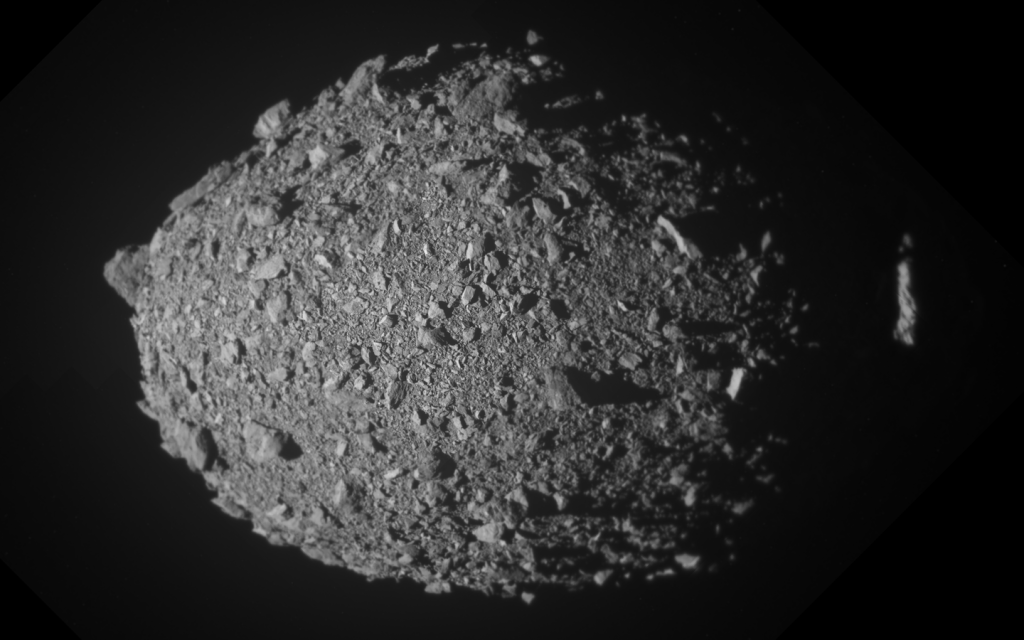
Comparison with previous missions also highlights just how complex space physics can be. The 2005 Deep Impact mission, which also involved crashing a probe into a celestial body, showed a smooth ejection pattern because the comet was made of fine, homogeneous material. Dimorphos, by contrast, had a rocky, irregular surface that altered the debris’ exit pattern—creating filamentous structures and chaotic movements.
For any future mission, this means it’s not enough to calculate the angle and speed of impact. It will be necessary to analyze in advance the composition and morphology of the target. What kind of rocks cover its surface? How might they fragment upon collision? What effect would the momentum of those fragments have on the body’s orbital dynamics? Without those answers, each planetary defense mission could have a far greater margin of error than expected.
The study, published in The Planetary Science Journal, underscores the need to model not only the collision itself but also the dispersion and momentum of all generated fragments. Fortunately, the European Space Agency’s Hera mission, scheduled to arrive at Dimorphos in 2026, will allow for more precise examination of the DART experiment’s outcome and help clarify the still-unknown variables.
DART achieved a historic milestone: deflecting an asteroid. But the debris’s unexpected behavior after the impact shows that in planetary defense, the details matter. Just like in a cosmic game of billiards, a millimetric deviation could mean the difference between saving Earth—or missing the crucial shot.
Reference:
- The Planetary Science Journal/High-speed Boulders and the Debris Field in DART Ejecta. Link
COMPARTE ESTE ARTICULO EN TUS REDES FAVORITAS:

Esta entrada también está disponible en:
 Español
Discover more from Cerebro Digital
Subscribe to get the latest posts sent to your email.