
A new study has challenged global climate change expectations: Antarctica’s ice sheet recorded an unprecedented mass increase between 2021 and 2023. This recovery, attributed to anomalous precipitation accumulation, raises new questions about Antarctic ice dynamics and its role in sea level rise.
An Unexpected Turn in Antarctica’s Ice Sheet Evolution

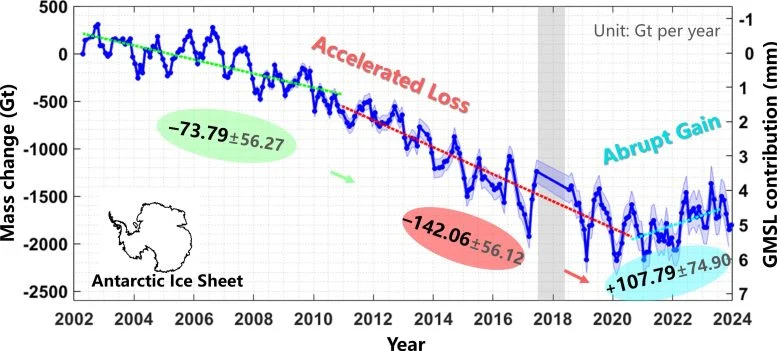
For decades, scientists observed with concern the progressive ice loss in Antarctica, particularly its western sector. This phenomenon, tracked via satellite gravimetry since 2002 through GRACE and GRACE-FO missions, has been a key indicator of global warming’s polar impact. However, a recent study published March 19, 2025 in Science China reveals the opposite trend: between 2021 and 2023, Antarctica recorded a net ice mass gain at an estimated rate of 107.79 ± 74.90 gigatons per year.
Led by Dr. Wei Wang and Professor Yunzhong Shen from Tongji University, the finding shows that for the first time in over two decades, the Antarctic ice sheet ceased being a positive factor in sea level rise and instead contributed to reducing it at a rate of –0.30 ± 0.21 mm per year. In other words, the frozen continent absorbed water rather than releasing it—a phenomenon unprecedented in recent satellite records.
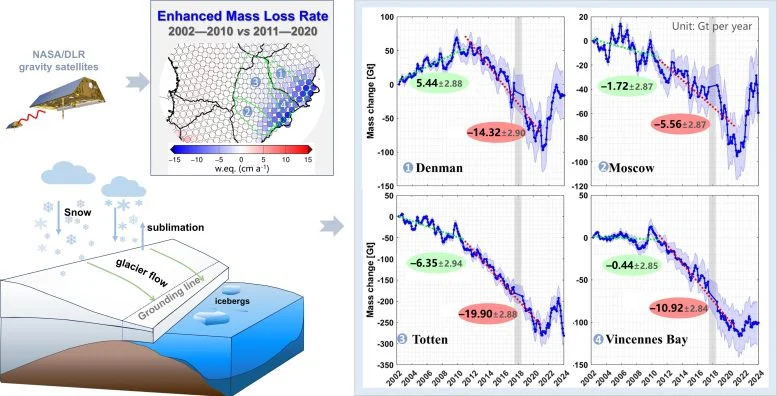
This change was particularly notable in eastern Antarctica, specifically the Totten, Moscow University, Denman, and Vincennes Bay glacier basins in Wilkes Land and Queen Mary Land. These areas, which intensified ice loss alarmingly between 2011-2020, reversed that trend and showed considerable mass gain during the new study period.
Causes of Recovery and Sea Level Impact
The main explanation points to anomalous precipitation accumulation—more snow than compensated for, even exceeded, Antarctica’s natural ice losses. This matters because the region normally loses mass through surface melting, iceberg calving, and glacier flow to the sea.
Historically, between 2002-2010, West Antarctica lost about –73.79 ± 56.27 Gt/year. That doubled to –142.06 ± 56.12 Gt/year between 2011-2020, mainly from accelerated melting in western and eastern regions. However, the recent 2021-2023 rebound not only halted that loss but showed mass increase with global sea level regulation effects.
In prior decades, Antarctic mass loss steadily contributed to sea level rise at 0.20 mm/year (2002-2010) and 0.39 mm/year (2011-2020). The new ice dynamic reversed that pattern, exerting inverse pressure on oceans.
Scientists caution this recovery shouldn’t be seen as a definitive trend shift or climate stabilization signal. Snow accumulation may relate to specific climate events or temporary meteorological variations, like increased snowfall driven by Southern Hemisphere atmospheric circulation.
A Precarious Balance: Warning Signs and Long-Term Risks

Despite this temporary recovery, key eastern Antarctica zones remain highly vulnerable. Totten, Denman, Moscow University, and Vincennes Bay basins stay under scientific watch due to destabilization potential. These hold enough ice to raise global sea levels over 7 meters if fully melted.
During 2011-2020, these four basins showed combined mass loss of 47.64 ± 8.14 Gt/year, 72.53% from surface mass reduction and 27.47% from increased ice discharge to the ocean. Their balance depends on atmospheric temperature and oceanic current changes eroding glacier bases.
Recent mass gains in these regions don’t mean safety. Rather, they underscore Antarctic climate system volatility, oscillating between extremes responding to precipitation, temperature, or ocean circulation changes. The ice has gained ground for now but could retreat equally fast if external conditions shift.
Antarctica surprised the world with net ice sheet growth for the first time in decades. This snow-driven phenomenon offers temporary climate crisis respite. However, it shouldn’t be seen as lasting recovery. Most vulnerable glacial structures remain threatened, and science must continue precise monitoring of this frozen giant whose fate has planetary repercussions.
Reference:
- Science China Earth Sciences/Spatiotemporal mass change rate analysis from 2002 to 2023 over the Antarctic Ice Sheet and four glacier basins in Wilkes-Queen Mary Land. Link
COMPARTE ESTE ARTICULO EN TUS REDES FAVORITAS:

Esta entrada también está disponible en:
 Español
Discover more from Cerebro Digital
Subscribe to get the latest posts sent to your email.