Human evolution is more complex than once thought. A study published in Nature Communications proposes a new way to interpret several fossils discovered in Asia. Researchers suggest that some may belong to Homo juluensis, a possible ancient human species that continues to generate scientific debate.
A new proposal to understand human diversity in Asia

For decades, human fossils found in Asia have posed a challenge for paleoanthropologists. Many of these remains do not clearly fit within known species such as Homo sapiens, the Neanderthals, or the Denisovans. This situation has created a complex picture, with mixed anatomical traits that make classification difficult.
A study published in Nature Communications, led by Christopher J. Bae and Xiujie Wu, proposes a new way to interpret this diversity. The researchers analyzed several Late Pleistocene fossils discovered in China and other regions of Asia, aiming to better organize their morphological variability.
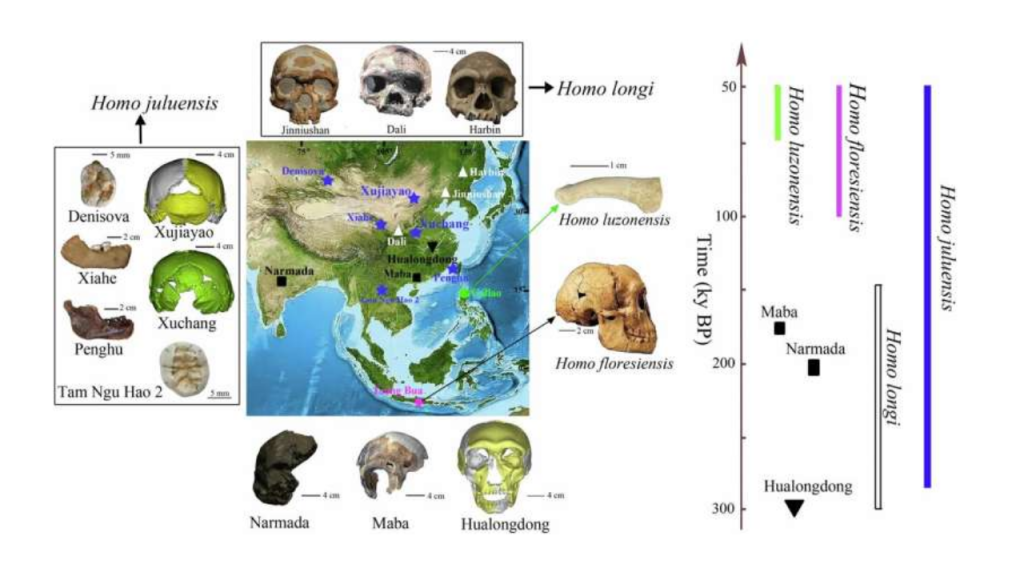
Among the remains studied are several skulls discovered at sites such as Xujiayao and Xuchang, which are known for presenting unusual characteristics. These fossils display large cranial structures, robust facial features, and a combination of traits that resemble both archaic humans and later populations.
To explain these differences, the authors suggest that certain fossils could be grouped within a population they call Homo juluensis. This name aims to identify a possible human lineage that lived in Asia during the Late Quaternary, roughly between hundreds of thousands and tens of thousands of years ago.
The goal of the study is not to announce a definitive discovery, but rather to offer a taxonomic hypothesis that may help interpret the Asian fossil record more clearly. According to the researchers, recognizing this diversity may help explain how different human populations coexisted and evolved in the region.
Anatomical traits and behavior of these ancient humans
Fossils associated with the proposal of Homo juluensis present anatomical characteristics that have drawn the attention of researchers. One of the most notable traits is the relatively large cranial size, which suggests a considerable brain volume for the time.
At the same time, these remains show a mixture of archaic and modern traits. For example, some fossils display thick cranial bones and robust structures typical of older human groups, while other anatomical details resemble later populations.
This mosaic of features is precisely what has generated debate for years. Instead of fitting perfectly within a single known species, many fossils from Asia appear to represent diverse populations that evolved in parallel.
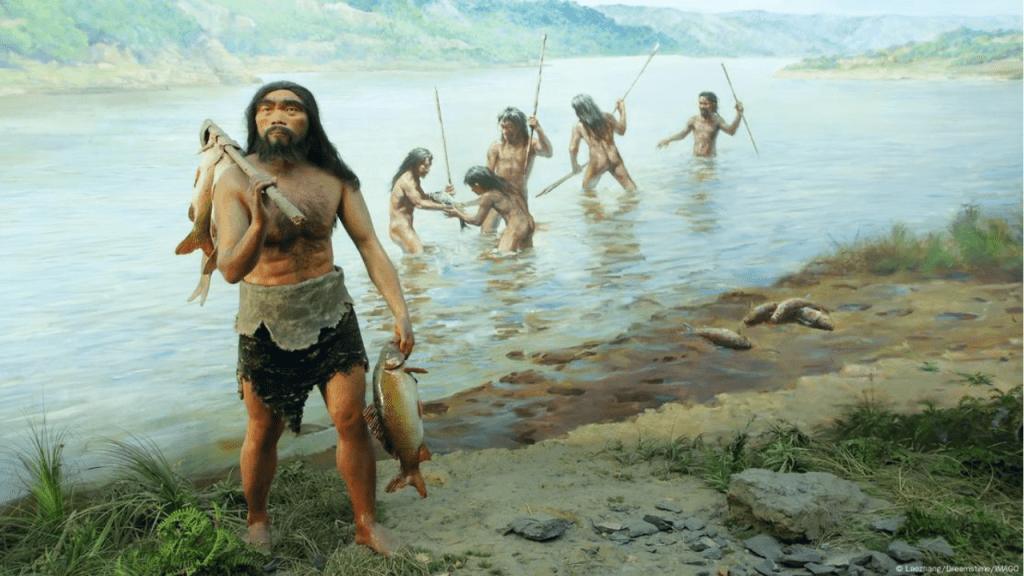
In addition to their anatomy, the archaeological context provides clues about their way of life. Several of the associated sites have revealed stone tools and remains of hunted animals. This suggests that these groups practiced hunting and gathering strategies, adapting to changing environments during the Pleistocene.
Although little is still known about their social or cultural behavior, the available evidence indicates that these populations were part of a complex human ecosystem in which different groups coexisted and possibly interacted with one another.
Denisovans and the complex human evolutionary tree
One of the most interesting aspects of the Homo juluensis proposal is its possible relationship with the Denisovans, an ancient human group identified mainly through ancient DNA. Unlike the Neanderthals, very few complete Denisovan fossils have been discovered.
This has made it difficult for scientists to associate physical remains with their genetic identity. Some researchers believe that certain fossils from Asia could belong to this population, but the evidence remains limited.
The study published in Nature Communications suggests that some of the fossils grouped as Homo juluensis could be related to Denisovans or might even represent part of that population. If this hypothesis is confirmed in the future, it could help connect genetic and fossil evidence within human evolutionary history.
This type of research reflects an important shift in paleoanthropology. For a long time, human evolution was thought to follow a relatively simple path. However, recent discoveries reveal a much more branched evolutionary tree, with multiple populations coexisting in different regions.
Asia, in particular, appears to have been an important center of human diversity, where several populations evolved, interacted, and possibly interbred over thousands of years.
The proposal of Homo juluensis does not represent a definitive discovery, but it offers a new way to interpret the complex diversity of ancient humans. Studies like this highlight that human evolution was a dynamic process, with multiple populations coexisting and leaving behind a fossil record we are still learning to understand.
Reference:
Nature Communications/Making sense of eastern Asian Late Quaternary hominin variability. Link
COMPARTE ESTE ARTICULO EN TUS REDES FAVORITAS:

Esta entrada también está disponible en:
 Español
Discover more from Cerebro Digital
Subscribe to get the latest posts sent to your email.