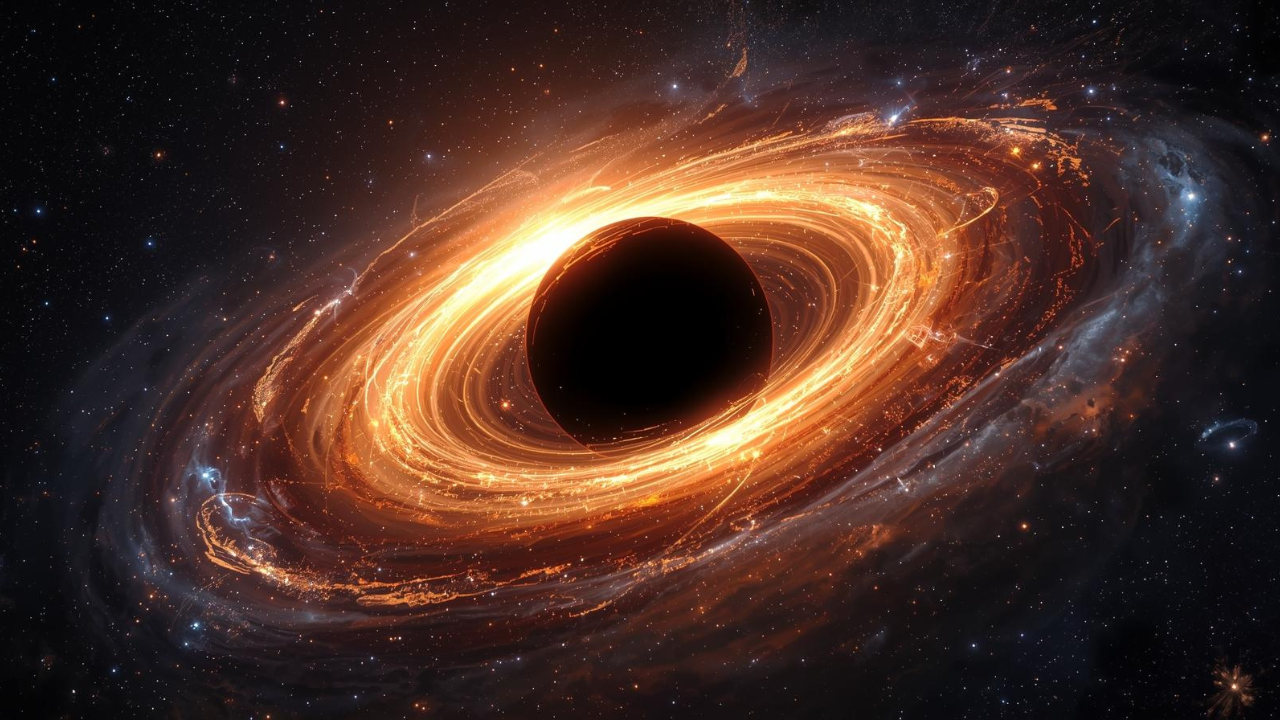
For decades, supermassive black holes have been among the greatest enigmas of the universe. Today, artificial intelligence has become a key ally in deciphering what telescopes still cannot clearly see. Thanks to neural networks trained with millions of simulations, astronomers are achieving more precise—and in some cases, profoundly revealing—interpretations of these cosmic giants.
Artificial intelligence as a new telescope of the cosmos
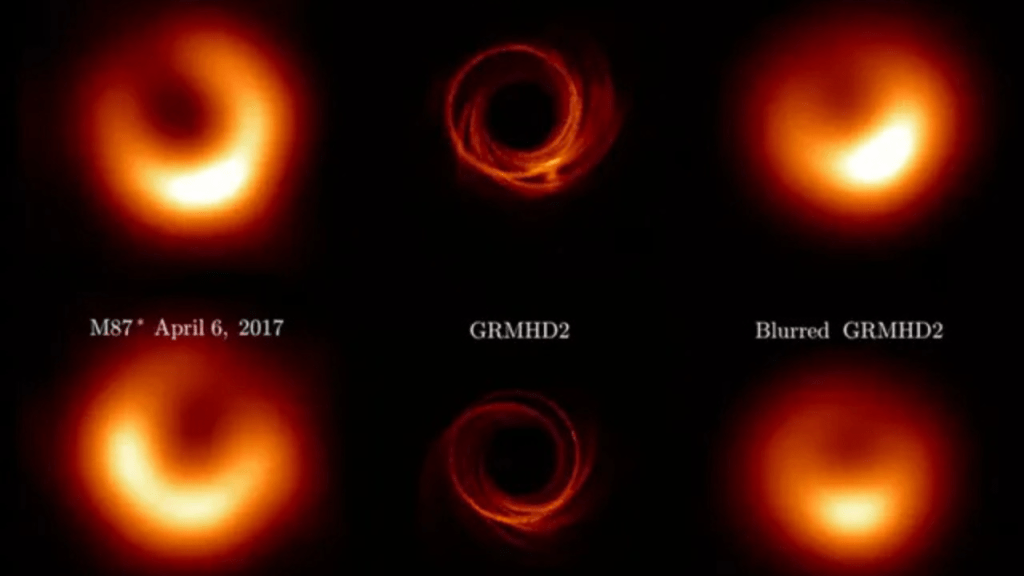
Direct observation of a black hole remains one of the greatest challenges of modern astronomy. Even ambitious projects such as the Event Horizon Telescope (EHT) do not produce traditional images, but complex reconstructions based on radio signals captured by radiotelescopes distributed across the planet. In this process, a significant portion of the information is discarded or simplified due to its difficult interpretation.
To address this limitation, researchers at the Morgridge Institute for Research in Wisconsin trained neural networks with millions of simulations of supermassive black holes. These simulations reproduce different physical scenarios and allow AI to learn to identify hidden patterns in incomplete or noisy data. Unlike classical methods, these systems do not ignore ambiguous information but analyze it in depth.
The result is a shift in approach: AI does not replace telescopes, but amplifies their capacity. By transforming seemingly chaotic data into more detailed models, astronomers can draw conclusions that were previously out of reach, opening a new stage in the study of the extreme universe.

Sagittarius A: a more extreme black hole than previously thought
One of the most striking advances from this approach is the new analysis of Sagittarius A, the supermassive black hole at the center of the Milky Way. Until now, its rotation speed was believed to be moderate or relatively high. However, AI‑based models point to a much more radical scenario.
Results suggest that Sagittarius A* may be spinning near its maximum speed allowed by physics, with its rotation axis oriented toward Earth. Moreover, the emission detected nearby would not be explained by a relativistic jet, but by extremely hot electrons within the surrounding accretion disk.
According to the Morgridge Institute for Research, these analyses also indicate that “magnetic fields in the accretion disk appear to behave differently from the usual theories about these disks.” This detail is crucial, since the rotation speed of a black hole directly influences space‑time curvature, the trajectory of light, and system stability, forcing reconsideration of widely accepted models.
Challenging theories and opening new scientific questions
Beyond specific results, the true value of using artificial intelligence in astronomy lies in its ability to question established theories. By revealing unexpected behaviors in magnetic fields and extreme dynamics, these models suggest that certain fundamental assumptions may require deep revision.
Researchers themselves emphasize caution. Far from presenting these findings as definitive conclusions, they consider them a first step. As neural networks are trained with more complex simulations and compared with new observations, it will be possible to refine models and validate—or refute—these extreme scenarios.
La colaboración entre inteligencia artificial y astronomía está transformando nuestra comprensión de los agujeros negros. Al rescatar información antes desaprovechada y plantear hipótesis más exigentes, la IA no solo mejora la resolución de los datos, sino que empuja a la ciencia a replantear sus propias bases. El universo sigue lleno de misterios, pero ahora contamos con una nueva herramienta para explorarlos.
Referencia:
- Throughput computing enables astronomers to use AI to decode iconic black holes. Link.
COMPARTE ESTE ARTICULO EN TUS REDES FAVORITAS:

Esta entrada también está disponible en:
 Español
Discover more from Cerebro Digital
Subscribe to get the latest posts sent to your email.