

A team of quantum physicists from the University of Toronto has sparked controversy by presenting experimental evidence of a phenomenon called “negative time”. Though debated, this finding could offer fresh perspectives on quantum mechanics’ peculiarities, showing how subatomic particles defy everyday rules without contradicting relativity’s core principles.
What is Negative Time?

The term “negative time” sounds like science fiction, but researchers use it for a specific phenomenon: some interactions appear to occur over a timeframe defying intuition, as if effect precedes cause.
This doesn’t mean backward time travel, but rather a quirk of particles’ probabilistic behavior in quantum mechanics, per Aephraim Steinberg, University of Toronto quantum physicist.
For instance, photons (light particles) interacting with atoms get absorbed and re-emitted, temporarily exciting atoms before they normalize. Measuring this span, researchers found under certain conditions it registered as negative time—a puzzling but valid quantum result.
The Experiment: A Window into the Unusual

Led by Daniela Angulo, the team designed an experiment with calibrated lasers to observe photon-atom interactions. After over two years refining, it revealed unexpected behavior: some light-matter interaction durations seemed less than zero—essentially negative time.
Steinberg’s analogy: Imagine a tunnel where cars enter and exit. Measuring average time for 1,000 cars, some appear to exit before entering. Previously dismissed as anomaly, lab confirmation proved it real and measurable.
Key: It doesn’t violate Einstein’s special relativity—no faster-than-light travel or time reversal. Quantum photons carry no information in these interactions, preserving causality and speed limits.
Subatomic particles don’t follow defined paths but probabilities, allowing “impossible” classical behaviors like observed negative duration.
Intense Scientific Debate
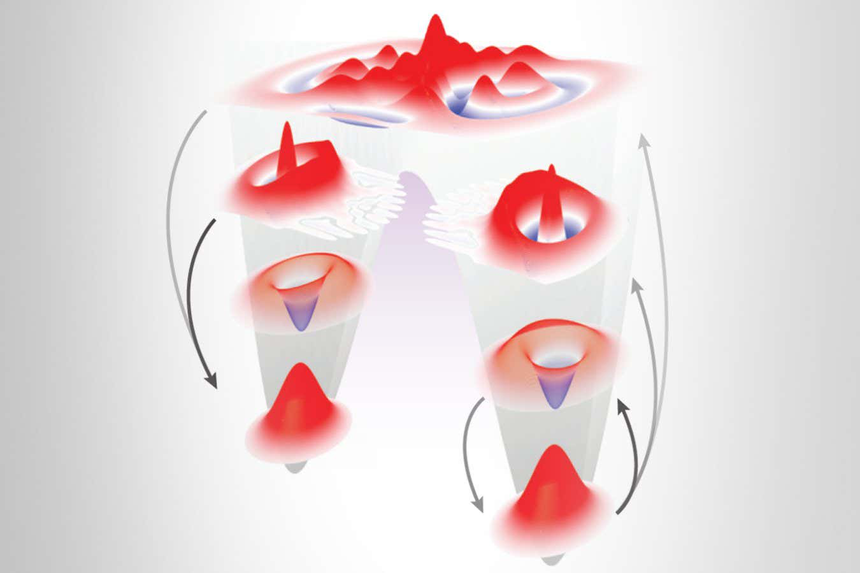
Negative time divides scientists. Some see it advancing quantum mechanics understanding; others, misleading interpretation.
Theoretical physicist Sabine Hossenfelder criticized it as misapplied terminology—unrelated to time flow, but photon-medium phase shifts.
Angulo and Steinberg counter it addresses fundamental light behavior questions and current interpretation limits. They admit “negative time” is provocative but highlights discovery’s importance, spurring debate.
Implications and Future
Though fascinating, practical applications remain unclear. Steinberg says it opens quantum exploration paths but no immediate tech leaps.
True value: Challenging physics intuition and exposing limits studying the subatomic universe.
Negative time reminds quantum mechanics defies classical norms. No radical time rethink, but a window into quantum complexities diverging from everyday reality.
Ultimately, the debate exemplifies how quantum discoveries challenge core perceptions, posing new universe questions.
Reference:
- arXiv/Experimental evidence that a photon can spend a negative amount of time in an atom cloud. Link.
COMPARTE ESTE ARTICULO EN TUS REDES FAVORITAS:

Esta entrada también está disponible en:
 Español
Discover more from Cerebro Digital
Subscribe to get the latest posts sent to your email.