
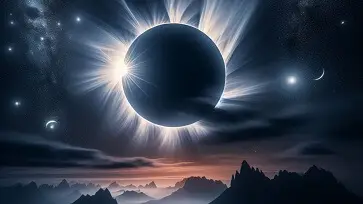
The year 2025 promises to be a true feast for night sky lovers. From planetary alignments to spectacular lunar eclipses, the firmament will treat us to unforgettable moments. Below, we present the 12 most impressive astronomical events of the year so you can mark your calendars and make sure you don’t miss them.

Astronomical events in chronological order
28 de febrero: Alineación planetaria
The sky will offer us a rare event when seven planets align. Saturn, Mercury, Venus, Jupiter, and Mars will be visible to the naked eye, while Uranus and Neptune will require binoculars. This alignment will be an excellent opportunity to observe the diversity of the solar system in a single night.
March 14: Blood Moon
The first total lunar eclipse of 2025 will transform the Moon into a mesmerizing reddish hue. This phenomenon occurs when the Earth blocks direct sunlight and only lets red tones through its atmosphere. A must-see celestial spectacle for night observers.
March 18-21: Double visibility of Venus
Venus, known as the “evening star” and the “morning star,” will be visible at both sunrise and sunset. This phenomenon is rare and can be easily seen from the northern hemisphere.
March 29: Partial solar eclipse
Parts of the northeastern United States, eastern Canada, Greenland, Europe, and northwest Africa will be able to enjoy a partial solar eclipse. Although not total, the partial obscuration of the Sun will offer a breathtaking view.
May 5-6: Peak of the Eta Aquarids meteor shower

This meteor shower, coming from Halley’s comet, is one of the most spectacular of the year. It is best observed in the Southern Hemisphere, although it is also visible from latitudes of up to 40°N. During its peak, up to 50 meteors per hour can be seen.
August 12: Approach of Venus and Jupiter
Venus and Jupiter will approach each other just 0° 52′ apart in the sky, creating a striking view. This pairing will be visible before dawn, with Venus shining with a magnitude of -4 and Jupiter with -1.9, both easily distinguishable with the naked eye.
The second total lunar eclipse of the year will be visible in Australia, Asia, Africa and Europe. This eclipse will be the longest since 2022, making it a must-attend event for astronomy enthusiasts.
September 21: Saturn at its best
Saturn will reach its opposition, which means it will be at its closest point to Earth and shine brightly in the night sky. This is the best time of year to observe its rings with a telescope.
November 3: Taurid meteor swarm
The Taurids of the North and South will have their maximum splendor during this date. Bright meteors and fireballs are expected, making it worth watching in the sky during the first week of November.
November 5: Largest Full Moon of the Year

This will be the largest Supermoon of 2025, with a size 7.9% larger and a brightness 16% more intense than an average full moon. An ideal night for lunar photography.
November 25: Approach of Venus and Mercury
This planetary pairing will be visible on the eastern horizon before dawn. Venus will shine with a magnitude of -3.9, while Mercury will have a magnitude of 2.0, making it difficult to detect without binoculars.
December 14: Peak of the Geminid meteor shower
Considered the most impressive meteor shower of the year, the Geminids will be able to produce up to 150 meteors per hour. The waning Moon will not interfere with visibility, making this event a highlight for 2025.
2025 will be an unforgettable year for astronomy enthusiasts. With eclipses, planetary alignments, and meteor showers, there’s something for everyone. The best part is that most of these astronomical events can be observed without the need for special equipment. Mark these dates on your calendar and get ready to enjoy the splendor of the cosmos.
Reference:
- 15 Top Astronomy Events 2025: Pictures & Viewing Tips. Link.
COMPARTE ESTE ARTICULO EN TUS REDES FAVORITAS:

Esta entrada también está disponible en:
 Español
Discover more from Cerebro Digital
Subscribe to get the latest posts sent to your email.


