For decades, a theoretical entity known as the demon of Pines remained hidden from experimentation. A recent study managed to observe it inside the superconductor strontium ruthenate, providing new information about how electrons interact in quantum materials and how they organize collectively.
What is the demon of Pines?
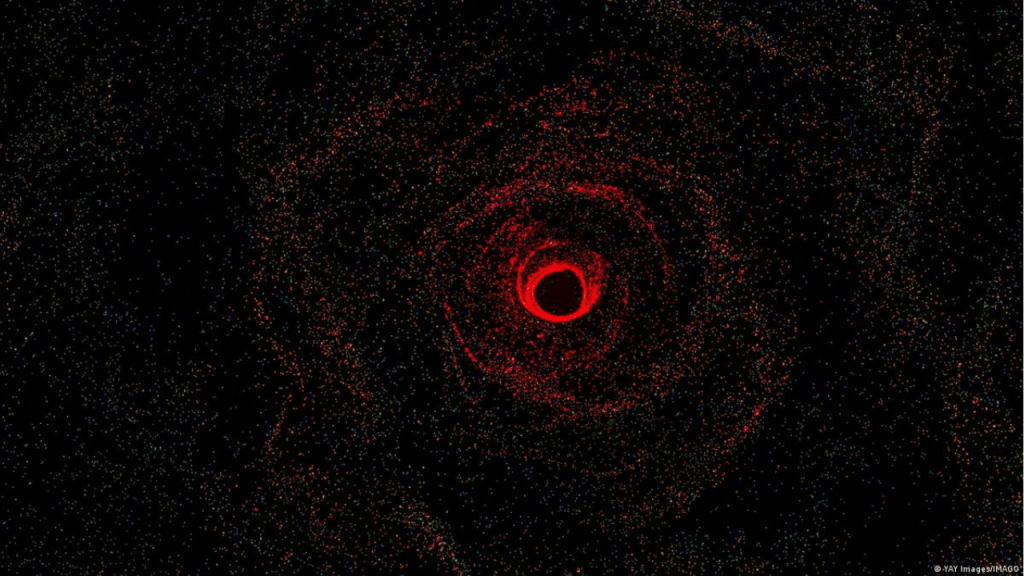
The demon of Pines is not a common particle like an electron or a photon. It is a quasiparticle, meaning a collective behavior of many electrons that act as if they were a single entity. It was predicted in the 1950s by physicist David Pines, who proposed that certain electronic systems could generate neutral oscillations that are difficult to detect.
Unlike ordinary plasmons, which carry an effective electric charge, this collective mode is essentially neutral. For that reason, it does not respond easily to light or to external electric fields. This property explains why it remained invisible for nearly seventy years, even though its existence was theoretically accepted.
In the study published in Nature, researchers showed that this demon appears as a three-dimensional acoustic plasmon. This means it behaves like a wave that transports energy among electrons, similar to a vibration, but without moving individual particles.
The material in which it was observed was strontium ruthenate (Sr₂RuO₄), a superconductor well known for its complex electronic properties. In this environment, electrons interact strongly with each other, favoring the emergence of exotic collective modes such as the demon of Pines.
This finding does not create a new theory of superconductivity, but it confirms that additional forms of electron interaction exist that do not directly depend on lattice vibrations. This broadens the range of possible mechanisms within quantum solids.
How was it observed?

Detecting the demon of Pines required a specialized technique called electron energy-loss spectroscopy. This method involves firing electrons at the material and measuring how much energy they lose when interacting with it. Each type of excitation leaves a characteristic signature in that energy loss.
The team observed a signal that did not correspond to phonons or conventional plasmons. Its energy and behavior matched what theory predicted for the demon of Pines. In addition, the signal appeared even without a net electric charge, reinforcing the idea that it was a neutral collective mode.
The use of high-purity crystals of Sr₂RuO₄ was crucial. Impurities usually mask this kind of phenomenon because they introduce noise into the measurements. The combination of precise instrumentation and well-controlled materials made it possible to isolate this effect for the first time.
This result is important because it validates an old prediction with direct experimental data. It is not an indirect inference, but a clear observation of collective electronic dynamics in a real superconductor.
What does it imply for superconductivity?

Superconductivity is characterized by the motion of electrons without electrical resistance. In many materials, it is explained through interaction with phonons, which are vibrations of the crystal lattice. However, the demon of Pines shows that interactions based solely on electrons can also exist.
The study does not claim that this mode is directly responsible for superconductivity in strontium ruthenate. What it does indicate is that electron–electron interactions can generate additional mechanisms of collective organization. This helps explain why some superconductors do not fit well within traditional models.
The authors suggest that this type of excitation could influence how electrons pair, although its exact role still needs to be investigated. For now, the demon of Pines is considered another piece of the puzzle rather than a definitive solution.
This discovery also serves as an experimental tool. By being able to measure this collective mode, scientists can study the internal electronic structure of certain superconductors in greater detail and test theories that previously existed only in equations.
The observation of the demon of Pines confirms a historic prediction and reveals new forms of electronic interaction in superconductors. Although it offers no immediate applications, it expands fundamental knowledge of quantum matter and opens paths for investigating alternative mechanisms of superconductivity with greater precision.
Reference:
- Nature / Pines’ demon observed as a 3D acoustic plasmon in Sr2RuO4. Link
COMPARTE ESTE ARTICULO EN TUS REDES FAVORITAS:

Esta entrada también está disponible en:
 Español
Discover more from Cerebro Digital
Subscribe to get the latest posts sent to your email.