
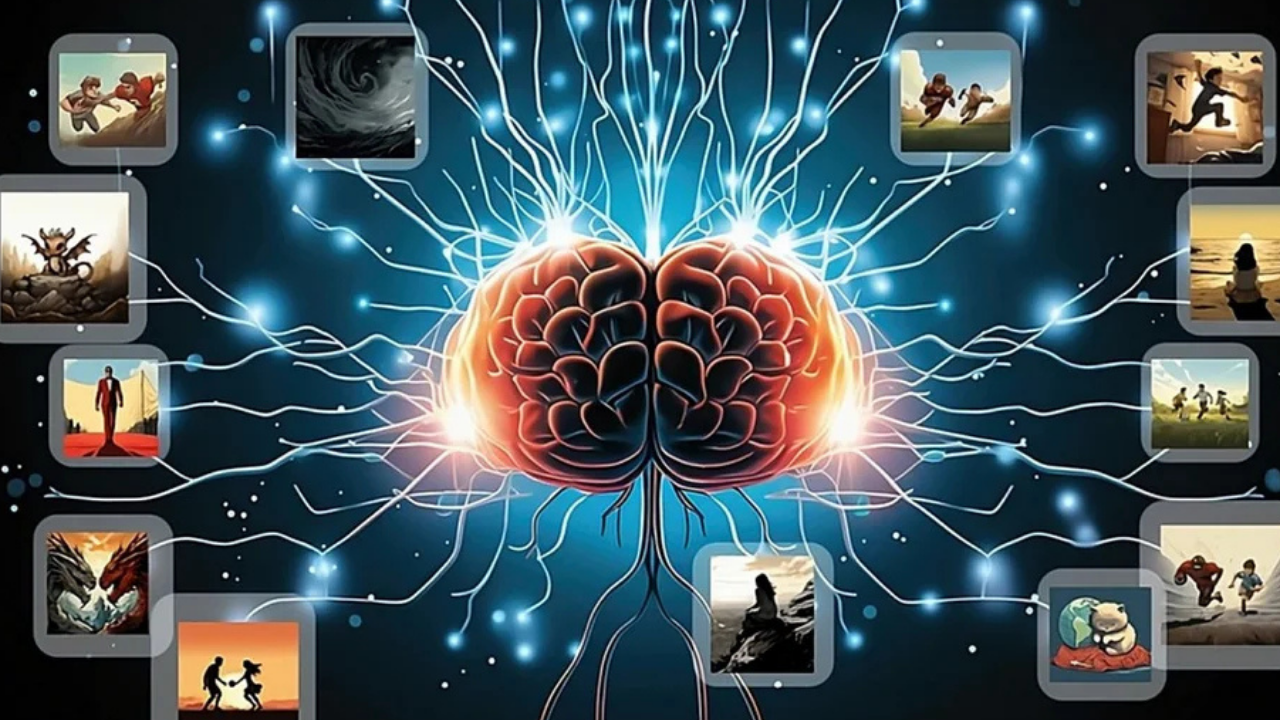
Autobiographical hypermnesia is a rare ability that allows people to recall personal experiences with great precision. Neuroscience studies it as a particular form of mental time travel, a process that links memory, identity, and temporal perception. Recent research in Neurocase analyzes this phenomenon from a clinical and cognitive perspective.
What is autobiographical hypermnesia?

Autobiographical hypermnesia, also known as highly superior autobiographical memory, is characterized by an exceptional ability to recall personal events with dates, contextual details, and associated emotions. Unlike ordinary memory, these recollections are not limited to isolated facts but preserve strong temporal organization and emotional structure.
People with this condition can rapidly and accurately evoke moments from their lives, especially significant or emotionally charged events. It is not about remembering more academic or technical information, but rather a memory focused on one’s own personal history. This distinguishes it from other cognitive abilities related to learning or general intelligence.
The article published in Neurocase describes hypermnesia as a particular expression of mental time travel, that is, the human capacity to mentally move back into the past. This process involves the activation of neural networks linked to episodic memory, such as the hippocampus and regions of the frontal lobe.
However, this ability is not always beneficial. Remembering with such clarity can intensify negative emotions associated with past experiences. For this reason, hypermnesia is not considered a universal advantage, but rather a condition with mixed effects on psychological well-being.
From a scientific perspective, its study is valuable because it helps explain how the brain stores, organizes, and retrieves personal memories. Analyzing these cases offers a unique window into the mechanisms that support memory and the construction of the self.
Mental time travel and memory of the future

Mental time travel does not only refer to recalling the past but also to imagining future situations. This process, known as episodic future thinking, relies on the same brain systems as autobiographical memory. Research in Neurocase highlights that both functions are closely related.
People with hypermnesia show a strong ability to reconstruct past scenes, suggesting a rich and detailed mental representation. That same structure allows them to project future scenarios coherently, although this does not mean predicting the future, but rather mentally simulating it.
This mechanism serves an adaptive function. It helps with planning, anticipating consequences, and making decisions. The brain combines real memories with new elements to create possible future situations. In individuals with hypermnesia, this simulation may be more precise due to the abundance of available autobiographical information.
The article emphasizes that memory does not operate as a fixed archive but as a dynamic system. Each act of recall involves reconstruction rather than simple reproduction. In this way, the past and the future are integrated within the same cognitive architecture that enables the individual to orient themselves in time.
Understanding this process is essential for studying memory disorders and for explaining how personal continuity is formed across the lifespan.
Implications for identity and consciousness

Autobiographical hypomnesia provides important insights into the relationship between memory and personal identity. Remembering with such detail strengthens the sense of continuity between past and present. Each memory serves as a reference point that helps define who one is and how one came to be.
The Neurocase study shows that mental time travel is not only a cognitive function but also a process that sustains self-awareness. The ability to relive past episodes allows experiences to be integrated and given meaning.
Nevertheless, this intensity can also amplify the emotional impact of memories. Memory, in these cases, is not neutral: it can reinforce positive emotions but also keep negative experiences vivid. This demonstrates that autobiographical memory plays an active role in emotional regulation.
From a clinical perspective, these findings help clarify disorders in which memory is altered, such as depression or post-traumatic stress disorder. Comparing these conditions with hypermnesia makes it possible to identify what happens when memories are scarce and what occurs when they are excessive.
Thus, hypomnesia is not only a neurological rarity but also a scientific tool for exploring how the brain constructs internal time and conscious experience.
Autobiographical hypermnesia confirms that memory is more than a record of the past: it is a system that connects memories, emotions, and future projections. The study in Neurocase shows that mental time travel is essential for understanding human identity and the deep functioning of consciousness.
Reference:
- Neurocase/Autobiographical hypermnesia as a particular form of mental time travel. Link
COMPARTE ESTE ARTICULO EN TUS REDES FAVORITAS:

Esta entrada también está disponible en:
 Español
Discover more from Cerebro Digital
Subscribe to get the latest posts sent to your email.